Blog Archive

Sunday, January 31, 2016

Hierarchy Begets Hierarchy

Let us be clear of one thing, for all of the rhetoric slung about by the an-cap community, capitalism cannot survive on it's own, without the state it is divest of power and cannot be sustained. This is a truth that seems to not penetrate the minds of the anarco-capitalist frame if mind. They seem to believe that individuals are capable of forming a capitalist society without the force of the state or any of the state's regulatory and infrastructure base; this is an absurd claim. Capitalism relies on the state to enforce the value of the currency that it provides by force. A twenty dollar bill is worth twenty dollars because uncle Sam says so, gun extended. Binding contracts are held together by the state through state law and the enforcement of said law by the state, the contract must be abided by because uncle Sam says so, gun extended.

Without the state to enforce the very concept of 'property rights' or any other rights, gun extended, the very concept of capitalism, not to mention laws, social contract, or money, falls apart. One can argue that the 'state' and 'the workplace' should be heavily democratized, and that that would help allow for proper checks and balances so as to diminish the power of hierarchy; a policy that I would agree with. However many of the institutions and systems that we covet as inalienable would be hard pressed to exist without a rule structure and enforcement of said structure; with force of law. Arbitrary, yes, but at this point I cannot see people working together without a system by which they can operate with a level of stability and regularity.

More often than not I am perplexed at the lack of nuance when the an-cap community argues against the use of force. I do not understand their argument. Force is immoral by definition? This is a nonsensical thing to state and not event he anarco-capitalists believe this; because they will accept the idea of 'self defense' as within the moral and legal rights of the individual, these things can be extended and retracted arbitrarily based upon said an-cap. Now, if said anarco-capitalist was a pacifist than I would say that they were more honest with their ideological beliefs, but since the entire idea of 'property rights' would be void if people could not use force to maintain property; well let's say no one would have any property but the brutes, as history has shown.

Capitalism requires the state, this is not an opinion, it is just a basic reality. There is too much that the state does, that the capitalist system does not do, that is required for a symbiotic relationship of mutual benefits. The state grants contract protection and property protection (patents and so forth for intellectual property) and in return the capitalist system sustains the government with a level of a tax base so as to maintain those systems of force, military, police, judiciary, prison, ect ect... This is why those things balloon while social programs are cut and shrunk under capitalist regimes; it is easier to maximize profit with a subdued and powerless mass of people than to work within the complexities of the human climate of society and the overarching social contract that allows us to thrive.

In other words, the capitalist system requires and enjoys force because of its obvious benefits bequeathed. However, because of the capitalist system, the state is required to create and balloon these protective measures of the capitalist system. These ballooning protective assets both put a strain on the capitalist system and the state, and they will continue to grow to excess and over burdensome traits due to the basic desires of both the state and the capitalist system. The state, however, will in time develop a basic social safety net; in order to maintain a basic level of social cohesion and control. This is a result of the capitalist system creating vast sums of inequality and the state having a basic duty to maintain a cohesive structure so as to grant order/security to the mass of people and the capitalist system; this is of great importance to both the capitalist and governing systems. The problem is that the capitalist system is too short sighted to understand that inequity is a threat to the capitalist system itself. As such, the shortsightedness blinds them to the fact that the social programs are needed and the excess of the police state is already bloated beyond reason and capacity; however the capitalist system demands the gutting of the social programs to create an even larger influx of money, either into the police state or back to themselves.

This unreasoned conflict of both the state and the capitalist system, not to mention the mass of people caught in the middle of the conflict/symbiotic/parasitic relationship, will threaten all three of the occupants; the public, the state, and the capitalist system. This is a great threat to all of the people/systems involved. As such one must question the problematic reality of the relationship between the capitalist system, the state, and the people, we must come to terms with the fact that a capitalist system requires a powerful state, without a powerful state the very system is under threat or is either too weak to be maintained, or will devolve to barbarous mercenary/mafia practices. Capitalism cannot be sustained without force, no patent could be enforced without it, no property rights could be maintained without it, the reality is that all capitalist institutions need a forceful institution to compliment it; this seems the only option.

The reality is that the hierarchy of the capitalist system begets a complicated hierarchic system within the state to protect and enforce the will/desire of capitalism itself. When we come to think of it, the most complex and unwieldy systems within the state are more often the most forceful, police, military, and judiciary, as stated before. It costs a lot to create/build/maintain these systems of the state, as such the capitalist system really doesn't dislike thee institutions nor find them a threat; at least until they are used against them to reign in their excess, a thing that causes them to regret their demanding to build them so large to begin with. Now, of course, the capitalists themselves do not necessarily personally demand the growth of the power/force institutions, however they benefit largest from them and would not exist without them; they do complain of them as such systems do cut into their profits, but rarely will they demand their cutting as to do so would threaten their safety both abroad and at home.

In international affairs the systems of force are used to secure, through violence or threat thereof, the economic interests of the capitalist system world wide. At home a police state is used to secure internal stability against the mass of people, where in the capitalist system resides as a base of operations, who are subjected to the brutality of the system from within. As obviously would happen the force deployed abroad is far more bloody and brutal than the force deployed at home, as they do not reside abroad in those 'savage places' and therefore do not care about the people or the level of violence perpetrated. At home the system 'tolerates' the mass of the public, but as time moves on the systems of force used abroad migrate back home and the brutality used on foreign soil begins to showcase itself more and more at home; along with the policing force beginning to behave more like an occupying force rather than a police force of the public, this is no surprise as they are occupying the country on the behalf of the corporate state rather than the public or event the state itself.

These costly systems of hierarchy beget each other, they require one another to live, so creating a system of democratization and checks and balances throughout the systems themselves would highly modify the behavior of all involved. Again, if we use things like unions, worker coops, and mandatory government service along with public education/civics to instill a level of societal responsibility throughout the masses, than we could perhaps achieve a more just and verdant society. The natural stratification of life towards hierarchy makes this difficult, capitalism magnifies and increases the problem significantly, and so one perhaps cannot stop stratification completely, but perhaps can minimize it enough so as to render it annoying but tolerable. Again, this is a difficult problem to confront based on the fact that the human condition is often riddled with awkward elements of counterintuitive fixtures throughout the human social stratum; thus making it difficult to know if democratization is the proper answer to all problems of hierarchy. However, as of yet there is one thing we do know, capitalism magnifies hierarchy to the point of absurdity and excess thereby making systems of hierarchy balloon out of proportion in an attempt to protect the hierarchic system of capitalism with even more bureaucratic systems of hierarchy branching farther and farther out from the source.

Friday, January 29, 2016

The Illusion Of Value

 
Let us come to terms with a truth that so many seem divest of reasoning power to grasp. Value is a human construct. There is no intrinsic value to anything; beyond those who can ascribe value toward objects and concepts. This must be understood if we as a human society are to move beyond our shallow societal concept in current use by the mass of people. Why is this important to understand? Simple, if we understand this than we are able to move into a much more reasonable territory of treatment towards our fellows and thereby a better structuring of society. We are currently in desperate need for such a restructuring in our world.

What would acknowledging this truth mean for us? Well, it would put to rest the irrational argument against fiat currency, because gold has just as much 'intrinsic value' as paper; none at all. We ascribe value to gold in as much as we ascribe value to paper or plastic; arbitrarily. This is an important thing to understand because it means many different structural changes can and should take place in our world and our economy.

As value is arbitrary, and entirely ascribed based on government and economy, we must understand that all value is thereby enforced by government force and then enacted though the economic system which the government endorses and thereby enforces it's power through force of law and arms. These things are important, because it creates a system of universal rationing that can be enforced and distributed or withheld throughout the populace through the economy. This is how the people are granted access to goods and services through the economy of rationing through a monetary rationing system enforced through the economy enforced by the power of the government.

This is and can be a 'good trick' in the sense of creating a universal rationing system so as to create cohesion and structure. However, the way in which we currently enforce said system is stacked against the mass of people towards a select few. If we understand that this is a form of rationing than we are able to operate under the reasoned understanding that a certain level of rationing should be a given, in the sense that if we lived in an acknowledged rationed economy than we would decry rationing as unjust, but since we live in a monetary rationed economy we seem to be fooled into thinking that we are 'free' of a rationed economy. This is obviously false, as monetary rationing is slightly more insidious than actual rationing, for the reason that we delude ourselves into believing that it isn't rationing. But if we are granted our pay/rations to buy/acquire our rationed portion of the economy based upon said number of rations we have been distributed, than we are still living in a 'scarcity economy' just being fooled into thinking that monetary  rationing is 'freer' than just a plain old rationed economy. It's a bate and switch, a mental trick we play on ourselves, so as to give us the illusion of freedom and equity though the 'chance of perhaps getting a larger portion of rations' through a monetary rationing system.

As such, we must come to grips with the fact that money is just a form of rationing pieces of economic involvement to the public at large; or a select group of a smaller clientele who can participate in said 'exclusive' economy of rations. Monetary rationing creates the structure of the social dimorphism of rich, middle class and poor and thereby is responsible for aspects of said disparities; it is the essence of capitalism. However, if certain rations are viewed as a given, shelter, food, water, education, healthcare, internet, basic income, overarching living wage ect, we eliminate a certain level of the inequitable nature of monetary rationing by infusing a certain levels of basic rationing into the structure of the system itself. I believe that it would be prudent to acknowledge these basic facts so as to solve one of the inevitable structural flaws deep within the system of monetary rationing itself.

This of course is a basic socialist type of tendency/criticism towards the inequity of the entirety of the capitalist system. However, if we are to understand that the new social structure of the now budding world culture/economy is anything to tell, we are in for a vast level of problems if we do not begin undergoing a vast level of change throughout the entirety of the world economic system as a whole. I do understand that these things are problematic without a world government, but as I have posted before it is a thing that we as humans should be calling for and structuring so as to begin to enact mass world reforms so as to reign in the corporate state's overreaching power grabs.

Wednesday, January 27, 2016

The Symptoms Of Capitalism

 
When one is sick, one suffers from symptoms, we see the symptoms and, in more reasonable medicine, attempts to address the root of the problem. In other instances, more extreme, the disease is so intractable that one cannot remove said disease but merely treat it as best as one can and limp along until the inevitable expiration of said body from said disease. In this way we are limited by our medical technology and our understanding of the many complexities that it entails.

There is one disease, however, that we know perfectly well. We have studied it, for hundreds of years, and ever more we come closer to recognizing it's solution. We are moving towards it's cure, towards it's ultimate end; lest it destroy us with it's malignancy. Capitalism, a disease once thought chronic, incurable by it's very nature as a deeply entrenched parasite, but now I believe we are nearing a solution.

However, one must start by defining the root of the disease; what it's primary make up is. Classism, this is the sole root debilitating ailment that is the capitalist system of economics. It is not the cause, but the root of the crippling ailment that keeps capitalism a malicious operating system. For the overall system of wealth aggregation and stratification is the true problem, but it manifests itself in physical form as classism; a separation of society through 'standing' or 'wealth' these things being forms of social dimorphism that segregate segments of society into groups.

Stratification creates the problem, first it is 'rich and poor' than it is 'rich and poor and other (racism)' than it is 'rich and poor and other (sexism and racism)' than it is 'rich and poor and other (homophobia, sexism and racism) and than it is 'rich and poor and other (xenophobia, homophobia, sexism and racism) ect ect... Eventually, should the poor realize itself and the rich respond in fear of losing status it becomes 'rich and middle class and poor and other' thereby granting the illusion that one can escape the misery of poverty and alienation, however, after a time the 'middle class' will be eroded and done away with by the wealthy as the fear that created it has been beaten back and so the cycle continues as it did before the advent of the 'middle class' and those toxic 'other' memes are recharged and thrown back out to the mass of 'poor' so as to distract them from the true cause of their suffering. One must remember that the toxic 'other' memes always lay latent in capitalist societies and become flared and obvious when the economy 'goes bad' and than go back in to sleep mod when the economy is 'doing good' but they never leave and are necessary for the preservation of the system of capitalism itself.

In other words, racism, sexism, xenophobia, homophobia, even the middle class itself, are all memes created for the self preservation of the capitalist system; think of them as an immune response system. They preserve the system of classism, and thereby capitalism itself, by creating distractions for the public at large to be lulled into complacency so that the parasite of capitalism can extract their labor and thereby generate wealth for itself. Thus the meme structure of capitalism is that of division, divide and conquer, by doing such the entire institution can and does generate vast sums of power and wealth by the virtue of it's 'confusing' the public. Capitalism is chaos controlled, not by a conscious mind, but rather a system of chaos that has only one goal; amassing more wealth and power, which thereby protects the system itself.

It has built into it many self generated protective measures, however, all of them rely on division and a lack of interconnectivity; as this is the foundation of classism itself, thereby making capitalism very individualistic in nature and often shortsighted system. All of these things (racism ect ect...) are meant to keep people, and most importantly minds, apart and thinking only for themselves; in other words capitalism makes everyone shortsighted, and this is itself a boon for the self preservation of capitalism, which makes the masses unable to see the true cause of their problems. This is how the system works, it inundates the people with delusions of grandeur so that they will not challenge the system itself, because they always have the "but someday I may get rich" kind of statement wandering through their heads, they fail to realize that it is an elaborate fantasy propagated by the capitalist system so as to preserve the system itself.

One must remember, one does not have to be rich to be happy, live well, or enjoy life to the fullest, you don't need to be rich to travel the world, see the sights or have fun; some levels of wealth are so extreme that you'd never be able to be spend the money. This level of opulence is, therefor, completely unnecessary and thereby does not justify itself. This is the brilliance of capitalism, it makes people believe that lie that extreme wealth is somehow 'just fine' without them even taking a step back to think about it; hell they don't event think about it when they do, they will immediately start justifying it because the meme 'but I may get rich some day' dances through their heads as soon as the thought of how unjustifiable it is walks into the room. These are old memes, memes that play on our own shortsighted and selfish tendencies; that's why they work so well.

However, it has come to my attention that there seems to be a slight recognition of the very undercurrent of memetics in our society nowadays. We are now able to see the 'man behind the curtain' as it were. This is actually great! As memetics entire goal is to raise awareness of undercurrents in thought and thought systems; how they operate and protect themselves. And I believe that we can now begin to apply memetic thought to the very system of capitalism here and now in the twenty-first century. Marx was right in his critique, but he didn't have the memetic engineering capacity that we have here and now. He couldn't see the underlying reality that ideas have lives and immune systems that protect those very lives; we have discovered this with religion in recent years, the works of Richard Dawkins and Daniel Dennett were the first pioneering endeavors into memetic idea space (credit to them).

I believe, if we are to succeed in defeating the parasite of capitalism, which is threatening our very existence due to climate change, we must begin a full scale examination and understanding of the memetic structure of capitalism. We must discover its weaknesses and its protectors. I believe that our main group of study should be the 'anarco-capitalist' movement; as they are the proprietors/generators of the defensive memes that the capitalist system uses to spread it's delusions and influence. This is but a small step, but the reality is that the world is running out of time and we are in dire need to solve both our economic and ecological problems that seem so interconnected in a death spiral of unimaginable proportions. We are the only ones who can save us from ourselves; let us hope we're not too late.

Monday, January 25, 2016

Humane Intervention

 
The world is cruel, the world is filled to brimming with suffering and terror oft beyond the wildest nightmares of even the most deranged, and we are the only ones who can combat this sorrowful truth. No one else, not cats or dogs or whales or seagulls and most especially not god, we are the only ones coming to save anyone or anything. If someone starves and we knew, it is therefore our collective fault, homelessness, starvation, needless suffering and disease; the blood be upon our heads. We, not god, stand by and watch with callus indifference as untold millions suffer and die from completely treatable and solvable problems. We are our saviors, we are our destroyers, we are the angels and demons we fear. No one is coming to save us, we must save each other.

Thereby I would place a great importance upon a new concept of 'invasion' within our newly forming world society. I propose, haughtily, that we 'invade' the strongholds of poverty and sorrow and declare peace. We must employ and educate the populace of those nations, teach/help them how to form a business, teach/help them how to build the infrastructure, teach/help them order their social structure and build friendships/alliances with those growing/developing countries. We must, in doing these things, employ those learning masses, yes the nation 'invading' must employ the populace until their broken/fractured economy is strong enough to support itself; this is part of the cost of peace. It should thereby be in the purview of the government structure to supplement and provide these services in an attempt to increase and maintain peace, for itself and the world, and there by increase prosperity across borders and bring the greater society together. This should be a government endeavor, paid and supplemented by the people.

What I am thereby imploring is the creation of a 'peace industrial complex' as it were. We must develop, as we now are capable, a new form of combat/world unity. I know that my basic structure seems a bit fractured, however, I merely am putting forth the concept of the very idea; I leave it up to smarter minds to develop and bring to fruition these very difficult concepts, as I am certainly not within the position of power to do so.

These goals are not 'lofty' rather they are but the logical extension our exhaustion of the 'old ways' of human conflict and barbarous behavior. We have reached the end road in the art of war, war now has the capacity to destroy everything; literally. Our power is beyond the capacity of our planet, at this stage of our development it is not only imperative that we move away from such behaviors, it is the only logical next step. We have out grown this phase of our cultural evolution.

One must remember the great philosopher Stan Lee's quote "With great power comes great responsibility" we now know that it is not the powerless or the weak who are 'responsible' for the way the world is, rather it is the powerful who hold the blame for all systemic social problems; if problems exist, it is because the elite do not choose to address them. This is the greatest reason why god, if god exists, is responsible for all the suffering on the earth; if he is all powerful and all good, than he has no excuse for the evil seen upon this world, barring of course we change the definitions of 'good' or 'power' to suit an inactive god.

I must stress that we can and should migrate away from our current status quo of behavior. The reality is that we, as a world, need to unite and begin to take seriously the very real problems that currently, and most certainly in the future, face our planet. We are the only ones who will save us. If anything I feel confident that, should we recognize and act, we are more than capable of doing what many say is impossible. I do believe we can do the difficult, we've done it before, and it is not the dreamers who try that are the problem, it is the doubters who just sit back and shake their heads saying "this is impractical, it will never work, why not try for less?" for though the dreamer may fail and cry at night over his loss that day, the doubter cries for nothing, for he has nothing to work for and therefore worth building or losing.

Perception And Presupposition

 
In our society we are bound by many problematic mental manacles that in our more primitive state would have served a purpose for basic species survival; that time has passed. Now we find ourselves floundering about in disagreement in and amongst each other, for seemingly pointless reasons, arguing back and forth about 'changes' taking place within our cultural/structural society. The question is why, for what purpose, and how do we solve these disagreements?

I find that our biggest problem is not that the changes are 'earth shattering' but rather they are treading upon arias that, in our more animalistic ancestry, would have remained relatively un-trodden; that of our perception. In many ways we find ourselves fighting against what we find as 'counter intuitive' due to the fact that animals do not rely on complex problem solving and rely more on rudimentary ways of going about their business; penis=male, vagina=female, ect. When someone comes along and says that those rudimentary judgments are 'flawed' or 'wrong' persons immediately become defensive; as we are questioning a part of their very animal survival mechanism.

We must understand that our brains were not made for complex society, we've built that through trial and error over countless centuries, so the fact that we find ourselves in this predicament should in no way surprise us. We're clever creatures, but we are still animals, we rely on the same rudimentary functions of basic survival; still pride ourselves on our basic animalistic urges and behaviors. I know it get's old, but it is easiest, when people have an awkward reaction to same sex relations, of any and all sorts, it is that very deep down primitive mind who speaks "What about producing children?" Now anyone worth their humanity knows that relationships are not solely based on that very biological function, but because we are animals we naturally trend towards this type of thinking; we, as animals, want to reproduce, it furthers the species.

But our problem of perception goes farther than that, as equating earlier, penis=masculine, vagina=feminine, these very presupposed definitions are also a problem. Neither of these gentiles can truly determine whether or not they will behave in this or that predetermined way. Yet we ascribe instant definitions to things before we have even acquainted ourselves with said individual attached to said appendage; even more strange is that if we see said attributes we have already mentally ascribed said appendage to them before conformation; in most cases. This is the limitations of the animal mind, we can over come some of it, as we have most certainly have grown over time. So, how is it that we can solve said issues?

The human mind is relatively malleable, people's perception is not 'ultimate' in any way, we must remember that our animal perception is very flawed and can easily be manipulated by forces beyond our control. Many people's gender identity is a factor beyond their control, along with sexual orientation, taste in food, appreciation of art, thought on beauty, so on and so forth; we all slightly perceive things differently. We can tell this in both good and bad ways, persons can become convinced they have a weight problem and develop an eating disorder, they may think they need to lose weight but in actuality are starving themselves to dangerously low levels of nutrition and body index. People can experience both audio, visual and tactile hallucinations, they can think they have experienced something and believe it in totality; it may have indeed happened in their mind, so they would not be lying.

Outside forces can and do play a part in human thinking and development, along with interior biological forces; both genetic and invasive. These things also make up our mental landscape along with our human experience and cultural upbringing. Wrap these things tight enough together and you have a very complex system of thought/experience all wrapped nicely into a very simple machine with simple impulses and simpler processes. The human mind may be malleable but the human animal is still very constrained within the animal world.

This is why, earlier, I have recommended that nihilism should be the next step in our philosophical journey towards adulthood. If the agnostic/atheist position of "until further evidence I will assume no god" holds up and the human species fosters and grows a sense of basic philosophical honesty. Than the next step in growth requires a similar agnostic/nihilist position of "until further evidence I will assume no intrinsic meaning" in order for us to grapple with the "what is our best course of action to organize our society?" question. We must come to grips with the facts that we are the originators of law, art, beauty, science, ect. Our minds and our perception is what define our lives and experience of the world, we make our future based upon how we perceive and define it. Yes of course we don't want to fall into the trap of 'thinking makes it real' for it takes more than thought alone to make reality; though thought is the first step.

In this I find that taking the nihilist position allows us to break down the presupposition barriers that we have erected. Our predefining  of things without evidence, or our use of oversimplified rudimentary thinking, is often what gets us into trouble. When we rely too much on that animalistic path of a+b=c when dealing with complex issues that require slightly counter intuitive thinking, we paint ourselves into a corner not worth standing in and get trapped trying to justify an unjustifiable position just because we held too much to the overly simple preconceptions of the past.

Our world is no longer the plains of savanna, we no longer clime the trees or swim the seas, we live in complex societies interwoven throughout the world. This is the human experience. If we are to survive and thrive in this new world we must break down these animalistic and primitive tendencies of our ancient heritage if we are to survive in this new world of cooperation. We are single no more and like the single cell we must join together in cooperation to form a cohesive body or be doomed to parish alone; it is time we unite and know that we are the only ones making the rules and the only ones obeying them. Our minds must grow up if we as a culture, as a species, are to grow beyond our selfish past and see things in the light of beauty and grandeur that I know we are capable of, so as to do wonders far grander than any of our predecessors could have even dreamed of and dared not even imagine, out of embarrassment, that we were capable of more than we knew.

Saturday, January 23, 2016

Political Thinking

 
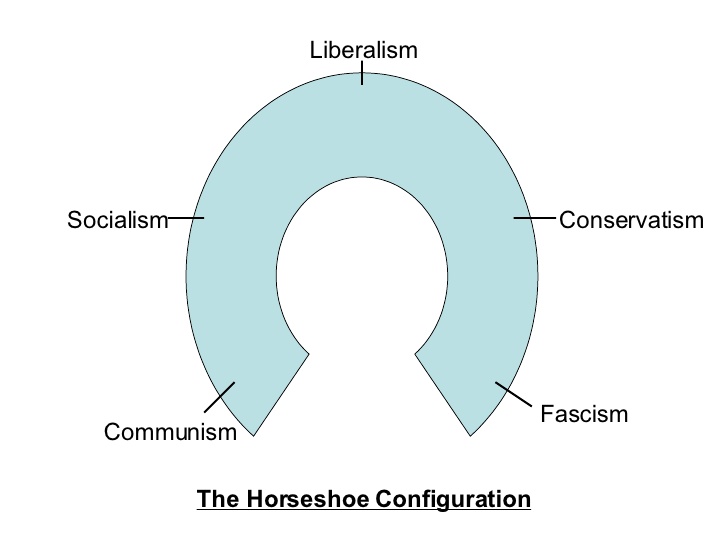
I have a problem with the concept of the horseshoe theory of politics. My main complaint is that I find that it falls under the "a pox on both their houses" non-reason argument. In other words, all political positions, left or right, when taken to their most extreme must nearly mirror one another in end result if taken to their farthest conclusions; aka authoritarianism. I take issue with this reasoning. I am uncertain if this is even a real criticism at all, and here is why.

I always categorized, and have heard it said, that the Russian revolution was a revolution of the left coopted by, and later ruled by, the right. Today we see the very same basic tactics of misinformation and 'pureness' from today's 'capitalist' dogmatists as we saw in 'communist' Russia. I am almost tempted to believe that the very concept of the right wing has nothing to do with economic tendencies at all, rather a mindset of authoritarian behavior and seeking. In this way it would render the 'horseshoe' theory of politics void; as I find such a hypothesis to be flawed in it's conception.

The authoritarian mindset does not care about ideology, it just want to tell and be told what to do; the beliefs are irrelevant. In this way, I would argue, communism cannot have a legitimate right wing in the sense that such a thing would undermine the very foundations of the system; the same is true of any democracy, in that power is meant to be spread out and not concentrated in both systems. Thus I would argue that the right wing is more of a malignant mindset rather than a legitimate political theory.

I know that such a statement may come off as an awkward criticism, however I think this is more true that the 'horseshoe' argument for the reason that authoritarianism does not care about anything but it's own authority and would thereby cloak itself in any and every ideological cloth in order to mask itself. This in no way is making a claim that certain systems do not contain more authoritarian structures within them than others, capitalism having authoritarianism built into the very framework of the ideological/structural makeup, while socialism or even communism would contain fewer authoritarian structures; though not divest of them. These statements are taken from the 'tenants' of the structures themselves, IE capitalism requires/contains people who have power over the working class, where as a socialist or communist system would attempt to divvy up the worker power between workers in as much as possible.

I believe that it is the authoritarian mindset, people wanting power over others along with people wanting to be told what to do, that is really the offending appendage of this entire equation. As I have stated earlier, authoritarianism does not care about the actual tenants of the beliefs, this would explain why we see so much hypocrisy in the midst of many belief systems that seem to have good ideas, and yet all of the good ideas are ignored by the rulers and merely used as empty platitudes by which to claim authority over the masses and hoodwink them into thinking they are living the dream when really they are squashed beneath the boot of authoritarianism.

Authoritarianism swings both ways, in that there are ruling authoritarians and followers who just want to be told what to do. Many people just want to go along to get along, so they gravitate towards a ruler who grants safety and security through obedience; this usually is entirely voluntary, no one is coercing them. Over time they begin to see the ruler as 'ever right' as they have provided safety and security, along with the feeling of safety and security (this is the most important part), and the ruler's ego (usually grandiose to start with, before said power has been attained) only swells larger and becomes even more malignant than previously. I must stress, authoritarians will wear any and every ideological cloak, they do not care about the ideology at all, it's all about the authoritarian's power and desire for more so.

If this is correct, as I believe it is, than the reality is more about the human mind than that of political makeup. Yes, political beliefs can foster authoritarianism, but authoritarian thinking cannot be controlled for in even the most free society as the very mindset of authoritarianism is a thing ingrained in a select percent of the human psyche and thereby means that our tending towards is more of an individual/group think weakness. I must stress again, authoritarians do not care about 'principles' or the merits of political beliefs or logic or reason, they are in it for their own power; this does not mean they do not have beliefs themselves, but that their beliefs are clouded by a desire for power.

How do we solve this problem? A difficult question, my only argument would be to foster a more pro-social societal structure; divvying up power and responsibility between the masses and attempting to ingrain a more interconnected behavior between the masses. This will not solve the problem, but I believe it will help mitigate it. I also believe that if we knew/understood this, that we hold these tendencies within us, that we could recognize them before they became too prevalent as a society and attempt to reintegrate ourselves into more social behavior. We have noticed in this modern era that people who feel powerless/disconnected from/in our society trend more toward authoritarian behavior than not; this is critical to understand if we are to combat this problem.

If we want to stop the slide into authoritarianism, we must work towards structuring society in a more integrated way. We must find a way to get people to feel involved and interconnected. I believe that a more socialist structure would help. Mandatory paid government service, in any capacity, would help in this way. More socialized labor, unions, worker coops and so forth. We must find ways to create checks and balances within the human social life so as to not flood people with too much 'people time' but also maintain solid relationships within the social structure and keep the masses feeling connected in and amongst themselves. I know that these observations may seem pithy, but I just have a real problem with the structuring of the entire political position of social behavior will lead to authoritarianism just as much as authoritarianism leads to authoritarianism; bad argument.

Friday, January 22, 2016

War In The Twentyfirst Century

If there is a truth to things, it is that things ever change, and yet they remain the same in their goals. War is our ever constant socioeconomic companion, war for resources, war for land, war for women, war for it's own sake. We are eclipsed in conflict, as humans seem propelled, and so we find ourselves stuck in a cycle of unproductive death and rebirth, rise and fall; ever the pendulum swings.

However, today, we find us now in a peculiar place, I always wondered what it must have felt like for the military commanders of old to realize that the rules of war that they had conducted themselves for their entire lives and those same rules that their forbears practiced, were totally obsolete. I believe that we have entered into just that paradigm today.

Our military minds seem flabbergasted at the efficiency of guerrilla war, after all, we've been losing to it since it arrived on the scene (in American terms) in Vietnam. After carful study I have come to a conclusion, our modern generals have not read Mao Zedong's 'On Guerrilla Warfare" or paid attention to the basic strategies guerrilla's conduct their recruitment and attack patterns. This is an unacceptable error, and if I were America's dictator I would most certainly have these people executed in the town square for their inept behavior.

Let us think for a moment, the twentieth century actually does know how to combat this type of combat; in fact we prevented this type of thing at the end of the second world war. We educated and rebuilt our enemies, we tried to get them back on their feet, reconciled with them and brought them to grips with some of the things their regimes had done in their name. Yet, we have failed to understand, and in fact have regressed in strategy and practice, to fight a cogent conflict with at least a semblance of a resolution; why?

In many ways I believe that we have fallen into the military industrial complex trap of "war for war's sake" which has become a major business boon for the weapons industry. We must remember, each bomb costs a fortune and each bomb can only be detonated once and so we spend fortunes to replace the ones we've used; this critique includes bullets and even military equipment that we leave behind on the battlefields and in the nations we've fought in; disposable expenses.

Placing these things aside, and that is nearly impossible to do, we must focus on the inefficiency that is conducting our war tactics; why can't we win? Well, a guerrilla war needs a maximum of two people to start, two people and a populace filled with boiling rage/legitimate reason to feel animus against the enemy; these individuals are often in poor countries. Then, all that is required is a solid recruitment, a few people in the beginning, to conduct the attack, and then, in expectance, the more powerful nation that they attacked will overreact and use excessive force; killing many civilians in the process. Bang! Instant recruitment tool, you have now recruited many angry people to the guerrilla ranks, and the perpetual motion device goes on.

You cannot win a guerilla war, short of committing mass genocide, you will forever be left with rage filled masses who will wish revenge upon you for the slaughter of innocence that you have perpetrated upon them. This is the only logical emotional response that said person can have, entirely reasonable, and they will enact those feelings; they must. And so, the question, how can you defeat a guerrilla war ?

We cannot continue to utilize our over reliance on air power, this is creating the problem, we must establish a solid ground force. Then, this is the revolutionary part, we must send in behind them both the army corps of engineers and the peace corps. The peace corps must become part of the military, but they must be unarmed, they must be relational, and they must interact and work with the masses of people of the enemy nation. The reality is they must, along with the army corps of engineers, help rebuild/hire/train the enemy nation. We must establish relationships with the masses, we must show them the humanity of their enemy along with the fact that we must take their humanity into account as well. Yes, we must combat the enemy who assaults innocence, but we cannot delve into the morass of barbarism along with them, because it will only serve to create an intractable conflict that has no end or possible reconciliation.

Let us be clear, war is always expensive, and so for those who say we cannot afford to both bomb and rebuild our enemy is not paying attention to how much money we're paying to fight without any clear path to peace. Right now, we are fighting in the middle east, the refugee crisis is exploding, and for obvious reasons; we've no plan for peace. We need people, not just troops, but engineers and individuals who can help establish the education for living in a rebuilt nation/economy. We must retrain people on how to run businesses, how to build buildings, bridges, and other infrastructure. They would require a completely rebuilt electric grid, and it would be up to us, as the more powerful nation, to provide them with a solid green grid with wind and solar renewables. We should look at this as an opportunity to both combat our enemies and the specter of climate change; as this too is driving the refugee crisis.

Now, let us establish a new rule, a rule that already exists but no one pays any attention to, the stronger bear more responsibility. This is just a fact, if the stronger nation does not restrain its power it will hit potential friends in the process. We cannot view an entire country as an enemy, and we cannot throw out their humanity as a whole when we combat them. If we keep killing, with the idea that civilian casualties are 'to be expected' or 'a necessary evil' than we will never stop the combat and the war will ever continue on.

Now, I know that my observation of "war for war's sake" makes this entire article's observation moot; after all, if we are utilizing war as a business, than no interest even exists in ending it. My proposition is that of 'how to combat a guerilla war' hopefully with a satisfactory ending. But I do understand that we are now living in the age of the dollar, and so unfortunately, we may be transfixed in an intractable conflict that may do more than kill those poor souls, but slowly work it's way back home as well.

Thursday, January 21, 2016

The Problem Of Sovereignty And Economy

 
Here in the United States we live out the nightmare of border economy conflict on a daily basis. The cries of "states rights" echo vapidly throughout our national dialogue; often spoken with less understanding than when thought. The meaningless trilling of these persons, of whom I (and most people, I would hope) hold little respect, is more of a commentary on the listlessness of their intellectual striving. Over the years I had come to understand the 'states rights' argument as a stall tactic for persons of little minds and even smaller vision to evade confronting both the moral economic difficulties of our national social structure and but 'put off till tomorrow' these difficult trials of the American experience. However, I have now come to understand the 'states rights' argument is an economic ploy to allow some states to allow for exploitive purposes that are meant to but benefit those of 'high standing' in our socio-economic stratum.

'Right to work' here, in American, means to us 'a right to work for less' whereby the state enforces low living standards; through low minimum wage and social programs. This is, as they justify, an attempt to 'woo' corporate migration to their state; thereby giving a supposed economic 'boon' to the residence. The argument is simple 'lower taxes+lower regulations+lower wages=more jobs/employment opportunity' now, putting aside the childishness of this overly simplified view; which is a difficult thing to do. One is left with a very peculiar intuition, that of 'employment for employment's sake' as a man who lived most of his early life in the south, a place infamous for its low standard of living, I can tell you with certitude that not every job is equal and not all pay is equitable.

If we look at the poverty in the south, which is undeniable, we can conclude that this system of thinking is not beneficial to those who live under said regime. Just driving around often takes you to places of economic desolation and societal despair; persons living together in family groups or poor neighborhoods, often getting by on cheap food and sports entertainment to pass the time and ignore, as best they can, the hardships of poverty. Now, many times, in these places these people are not unemployed; they have jobs, usually more than one. The reality is that no pressure is placed upon the employer to raise wages because, remember the 'wooing' of corporate migration, should the state allow any form of pressure to face the corporate structure, the corporate state will up and leave (or threaten to do so) and place the populace in an even worse place than when they weren't there; but not by much I'd argue. And so the state spends considerate recourses, or should I say doesn't, to keep these entities in the state. As a former government employee of a southern state I can say that my wages were either minimum wage or a few dollars higher; both unlivable. Thereby, by paying the people who work for the government a low wage, it takes the state out of the 'competitor market' for wages and allows full exploitation by the corporate state; they also pay about the same in wages.

This means that the only answer for those poor employees of the south is for either A. federal assistance and federal laws to raise wages to boost market participation, or B. union and worker coop organizations placing pressure upon the corporate state from within the market itself, or of course C. a combination of both. However, many southern 'right to work' states have done as much as they can to decimate unions, and most certainly would stifle and hamstring worker coop movements; thus leaving the federal government the last man standing in the fight for individual economic autonomy. Of course, our good friends in the south, are doing everything they can to spread the gospel of 'Libertarianism' wherever their wretched tongs may speak; the anti-government ideology of our dear friend Ayn Rand, the slinger of screeds not worth reading. Of course it has its roots in that of 'classical liberalism' which emigrated from Europe to the United States under new names, but this would take an eternity to document here; and this isn't the main crux of the argument anyway.

The main thing to state is that because of the 'states rights' argument, that allowance of the borders of states to determine the economic status of our fellow humans within the United States, has granted pockets of poverty that would boggle the mind of many a shore bound city dweller on the coast of our nation; in relative comfort. We are allowing the rape and pillage of our fellows for the 'comfort' of the corporate state. This 'run to lower ground/race to the bottom' economic system is decimating our national/intellectual/creative infrastructure and leaving us poorer, not only physically, but competitively.

When the 'states rights' claim is made, what they are really espousing is a form of state sovereignty, this is the idea that 'we can do what we want within our state, without being forced to do anything by outward forces' more like a 'freedom of choice' argument. However, I've noticed a flaw, the state actually isn't 'free' if in fact they are 'reliant' on the corporate state for income, ie. taxes, and thereby are forced to 'create' a 'healthy business climate' in order to attract the attention of the business community to settle in their state. In effect, their 'rights' are dictated by the desires of corporate interest, they dictate what living conditions are 'reasonable' based on their own personal comfort; low taxes, low wages, low regulations, ect. This in and of itself should be considered a form of blackmail "do what we want or suffer the economic consequences" thereby insuring that the corporate state has total manipulative control; not only over the citizenry, but over the state itself.

However, due to this blackmail, really it's a form of negotiation with economic terrorists, the state guts its infrastructure through tax cuts; the schools are weakened, the roads and highways go unpaved, the public employees wages stagnate and shrink, and the deficit explodes as poverty increases and the reliance on the social safety-net increases the burden of said poverty, not on the corporate entity which promised employment and jobs, on the state; who will later go, hand out, to the federal government in desperate need of aid for a situation that their own stupid state rulers created through 'creating a better business climate' and thereby crushed their own economy. This speaks nothing of the repeal of regulations, all the way from ecological regulation (which keeps water and air clean), right down to banking and insurance regulation (that keeps predatory behavior in check), along with medical regulations (granting protection from malfeasance, malpractice, extortion and bad drug practices). All of these things 'make a better business climate' but do not necessarily make a better economy or a better society.

This problem is only compounded by one other colossal problem 'free trade' which makes this 'corporate state runs to the lowest common denominator' behavior even worse. It makes this destructive behavior global in scale; thusly guaranteeing a free flow of exploitation throughout the world, free of consequences and the fear of prosecution, as the United Nations is seemingly hogtied to enact any form of corporate prosecution. This is a nightmare scenario, free wandering all powerful corporate entities meandering about like locusts; devouring all desired resources until exhaustion and then moving on to another land to decimate; and yet it is the precise model we have built. This time, however, there is no federal government with even the slightest chance of regulatory power; or is there?

I believe it is time for this, humanity has been moving towards this since the first family merged with another family, of whom they had no relation, for protection and cooperation. I do not see 'globalization' ending, I cannot see it stopping because we have been trending in this direction since the dawn of cooperation. So, I propose making the United Nations a world governing body. One who implements a global living wage, tied to global inflation, I propose that we develop a global minimum income, and a global system of central planning for an effort to create a solid global infrastructure. There is a way to end 'borders' but not definitively so, in an effort to transition to a global society. We already see a thin film of an over-culture developing across the internet, with societies slowly but surly developing exposure (both good and bad) to other cultures and beginning a slight transition towards cultural assimilation.

Yes, there can be concerns about cultural assimilation, but not all assimilation is bad, if we were able to develop, say international unions, we would be able to create international pressure on the corporate state, the same could be said of international worker coops and a global living wage. None of these things even mentioning the ideas of global universal education/healthcare/income and so forth. I know that the nay sayers and visionless hacks would crow "how could we afford such a thing?!" but I care little for their uncreative approaches to what clearly is an inevitable event; barring of course our global extinction due to climate change. We need to do this, we need to (so long as we allow capitalism to exist) apply the choke chain around their neck and tell them to "Heel!!!" or face the consequence of the corporate death penalty. This is an entirely unacceptable means of conducting our societal and global affairs. We cannot continue to allow the bands of marauding corporate institutions to gallop across our world, trampling the human masses underfoot, unchecked and unaccountable. Yes, I know that what I propose is no utopic vision, we all cringe at the idea of our President being just but a lowly parliamentary figure in the halls of the UN, but let us remember, at this moment, because of our borders, we are being taken advantage of by institutions who have no loyalty and who will leave us high and dry just to find a lower paying nation. It's time for a global floor on wages, and it's time for unions without borders, it's time once again for The Internationale to ring out across the world in song. We need a united world, we need economic accountability and autonomy, this would be but a small step in a broader fight; the fight for dignity, equality, freedom and justice never ends. I propose a binding United Nations; a one world government.

Wednesday, January 20, 2016

The "Meaning" Of Life: It's A Trap!

 
Let's start slow... real slow; as one builds pleasure through procrastination. I'm gonna talk about nihilism, sound's oxymoronic I know, but from my prospective we are all respective nihilists; much as the New Atheist movement correctly points out 'we're all atheists, we just go one god further than those who don't' an apt thing to point out. There cannot be such a thing as intrinsic value! No, there cannot be. This in no way destroys the concept of 'value' one can personally value a thing and project one's own feelings/desires upon said thing, but most certainly said thing is divest of such values should the valuer cease to ascribe said properties/traits to said thing.

Without an observer to project meaning, meaning does not exist. This is not controversial, I cannot see how it can be, as we participate in this act daily. Let us think of a basic scenario, one is walking down the street, passing people, one knows none of these people, they therefore have little 'value' on a personal level; what value do they have? They could be mothers, fathers, children, whatever they may be; yet we do not intrinsically ascribe, partially because we do not know, these traits to these strangers. Even 'human worth' is only a thing that can be ascribed to those who believe in such a concept, tigers do not believe in human worth, and so if an individual does not participate in the belief of 'human worth' one cannot argue such an thing is intrinsic.

I have oft come into conflict with individuals who argue that nihilism is inherently destructive, even Fredrick Nietzsche feared the 'potential' of what the realization of nihilism; and so I shall argue. Nihilism can be destructive in the sense that people of lesser intellectual leanings, often Christian apologists who ask "what's to stop me from raping or killing, if there is no absolute moral law" types, can than take the idea of no "intrinsic value" and just run with it to their own selfish ends. However, they will come quickly to realize that not everyone shares their opinion and probably won't do well, just because one is a nihilist doesn't mean that one doesn't create one's values. Nietzsche himself called for a transvaluation of all values, in other words a seeking throughout all of man's human constructed values and seeing which would be worthy in the post Christian society that he foresaw and feared; precisely because he feared those who could not take the truth that no intrinsic meaning existed, we had to make our own meaning and had been doing it all along; now we'd just be conscious of it.

I cannot see why understanding that nothing has any "intrinsic meaning" is destructive, the meaning we as individuals give it should be enough, sure that meaning may mean nothing in the end but by than I'll be dead and won't know that my opinion on the subject is void. As an example, marriage has changes many definitions and thereby meanings over the years/century's and yet it's meaning of one hundred years ago is now different than it is today. Is the definition meaningless now? Or has our culture just changed, for convenience, the properties of marriage to suit our new society; the answer is obvious. However, it would basically make the term 'marriage' in an absolute sense of the word, meaningless. Morality is no exception, what once was 'moral' is now abominable, it was once moral to take slaves, not so any longer. Morality has changed and shifted with humanity as humanity has changed and shifted, this is exactly what Nietzsche wanted people to do, create their own morals, the Ubermench was a person who did this and transcended the old ways of religious dogmatism and inflexible/irrational moral absolutes. Gay's aren't to be stoned, they're to be loved; an exact contradiction in accordance to pious teachings of morality.

Nihilism goes farther though, it applies to our philosophy as well, and forces us to make changes throughout in order shape the future that is to come by being flexible. We will change again, precisely because no 'intrinsic meaning' exists. This does not apply to things like science which are cold calculations in mathematical terms, science describes reality, it gives it no meaning beyond the meaning we give it. Nihilism has destroyed all morals, in the sense that it has shown us that we are morality's maker and enforcer, thereby morality is not 'intrinsic' to the universe, the universe is cruel and unjust unless we bring justice to it; and justice itself only has meaning to those who believe in justice. Over all I would say that humanity's struggle is to understand that all we create has no 'intrinsic' meaning. We can pragmatically 'go along to get along' but in doing so we are accepting the inevitable 'value' changes that take place, so yes, pragmatism can fully remain functional in nihilism.

I still do not understand how nihilism is intrinsically destructive; as nihilism itself argues against intrinsic value judgments in and of themselves. Would this not make nihilism benign, unless of course one values it as destructive. I view myself as a passive nihilist, I in no way work to destroy meaning, lest of course said thing is destructive in it's own right; aka religions/political irrationality. But I cannot see why changing meanings is destructive, unless one argues that the previous meaning was destroyed and thereby said thing 'in idea space' was obliterated. To change does not intrinsically mean to destroy, though one can do such a thing, and yes, destruction is not inherently bad; many things are not worth defending or preserving. Yes, I would agree that all persons struggle with meaning, both collectively and individually, but this is inevitable and part of the very frame of nihilistic thinking, the perpetual flux of definition exemplifies the very argument that nothing has meaning beyond what we ascribe to it.

Why do I delve into this? Is there any value, pun intended, to understanding such a basic concept of the very framework of our societal structure? Of course there is, I wouldn't be doing this if there wasn't. Another example, one with meaning in our own world of value judgments, gender. Yes, the beloved Admiral Ackbar was indeed an apt harbinger for this topic. What about gender roles and descriptions is definitive?

Firstly, gender and sex are often utilized as interchangeable. Example, genitalia is used as a solid descriptor of gender, penis=masculine, vagina=feminine; man wear pants women wear dresses type of over simplified human relational behavior. Why do we do this? Simple, it is a form of social dimorphism, people need to easily identify where the vaginas and penises are hiding; ya know, so they can reproduce. This is a very primitive form of society, it still ascribes 'value' braised solely on what you're packing between your thighs; you're not worth being engaged emotionally or sexually because of the simple fact that you may possess the wrong bits of flesh down below.

Secondly, virginity is still prized for females and seen as a social failure of males; curious as the men must be fucking something in order to lose their virginity and females are seen as strictly off limits, must be fucking other guys, except that too is seen as 'less manly' so probably not. This is a colossal error of societal misguidedness. Again, a primitive hold over from our ancient past, women were valued as property to be traded between males for advantages and business/family endeavors. We place these values and descriptors on our fellows based only on the fact that one has one piece and the other has the opposite; completely arbitrary.

These things have changed, yes of course we have hold overs who wish to reimplement the ways of old, but such persons are viewed as they should be; regressive malcontents. I am certainly not saying that the transgendered movement has been fully embraced, they most certainly face a level of arbitrary discrimination that boggles my mind, but we hopefully shall overcome such non-reasoned behavior as 'It's a trap!' to immediately disregard/sneer at acts of male femininity or the immediate 'butch bull dyke' for a masculine woman. We must recognize, 'value' is arbitrary because it is not intrinsic, we create 'value' and 'meaning' through our own minds; individual, where it starts, and collective, where it ends. Thus, 'being' a woman is no more connected to bearing children as 'being' a man is connected to one's inability to do said act. One can embrace a woman who's womb cannot bear children and call her a woman in as much as he can embrace a woman whose womb can bear children in as much as he can embrace a woman who has, or never had, a womb at all. The act of 'being' a woman often entails more than said individual procreative task.

Now I do understand that I cannot in any way 'intrinsically' ascribe what it is to be a woman or a man, as I have just argued that no intrinsic value can be ascribed to such things. But that is the exact point that I mean to make. If one means to argue that the narrow gender definitions of male and female are the complete totality of what it is to be male or female one would most certainly be hard pressed to defend the changes that have taken place over the countless generations of the human species. Things change ever so, marriage, from polygamy to monogamy; both for different societal reasons, as in the past polygamy allowed for fast breeding that allowed tribes to overtake one another by sheer numbers, and monogamy allowing people to focus on the sharp change from physical survival to economic survival. Of course these things can and have changed, homosexual paring is now protected under the law, and I certainly would not be surprised if polygamy returned; as it was just as arbitrarily banned as gay marriage had been.

The point is, no intrinsic meaning exists and this in no way is some dreaded horror, matter of fact, it actually is a boon to us as a species. Should we recognize that such things are arbitrarily imposed upon us as a society and as individuals, we could be able to shrug off the once ever so 'earth shattering' events of societal change. The reality is that we redefine terms at will throughout our world, I cannot see why this is either 'terrifying' or 'destructive' it is but an aspect of our life, and in reality it is the very basis of pragmatism; for if things were intrinsically valued as a certain thing, one could not pragmatically change anything, as things would be set in stone. Some persons may indeed find this difficult, they may wish for 'absolute meaning' but the truth of the matter is that without a person to give meaning no meaning exists at all; thusly the extinction of humanity would render all human achievements worthless, as no one could give any of them value. I feel that we must accept this variant of nihilism if we are to grow as a species, the statement "there is no intrinsic value" should in no way cause dismay or displeasure; it should just be seen as a descriptor of life itself, as science is. We must move beyond this childish reliance on 'absolute meaning' and grow toward an understanding of life in a much more mature fashion. We are children no more.

Let The Games Begin

 Let the misery now commence. My fellow compatriots of indignant outrage, I greet thee with a slight smirk and raise of the eyebrow, my complacency has grown malignant and it is at this time I feel a stirring in my inmost parts that is neither arousal nor indigestion and so, as one must, I take to the net to rant and rave in a show of disgust and complaint that on most days rivals a mad man and on off days keeps pace with him. I am tired of awaiting a voice of scorn and malice who at the least has the capability of relative critique, and seeing as how I have waited in vain for such a voice I have decided to allow said muse to speak though me; an inefficient and frail vessel, but a vessel none the less. I quaff the cup of bitterness gleefully and prep myself to tear into the foul carcass of our rotting society, filled brimming with inept artists and leaders worth little more than fodder for my distain. But please, do not despair, not all light has gone from the world; just most. I am tired of this, tired of what passes off for talent, tired of what passes off for greatness, tired of small thinking 'people of higher status' who couldn't dream big if vision kicked down their door and sodomized them with genius. No, this must end, so I have come; let the misery now commence.